

A bottle cap may preserve traces of trade and consumption. A worn sack can carry the history of the hands that lifted it. A broken railway seat may point back to an abandoned economic system, while a fragment recovered from a destroyed building can become evidence of a place, a life and a memory.
For artists working across Africa and the Middle East, unwanted materials are not simply inexpensive alternatives to paint, stone or bronze. They are archives.
El Anatsui, Afra Al Suwaidi, Ibrahim Mahama, Shareef Sarhan and eL Seed approach the subject from very different perspectives. Yet their practices share one important idea: materials society considers useless can still hold political, cultural and emotional meaning.

Their work is not really about making rubbish attractive. It is about revealing what was already hidden inside it.
El Anatsui: Metal That Moves Like Fabric
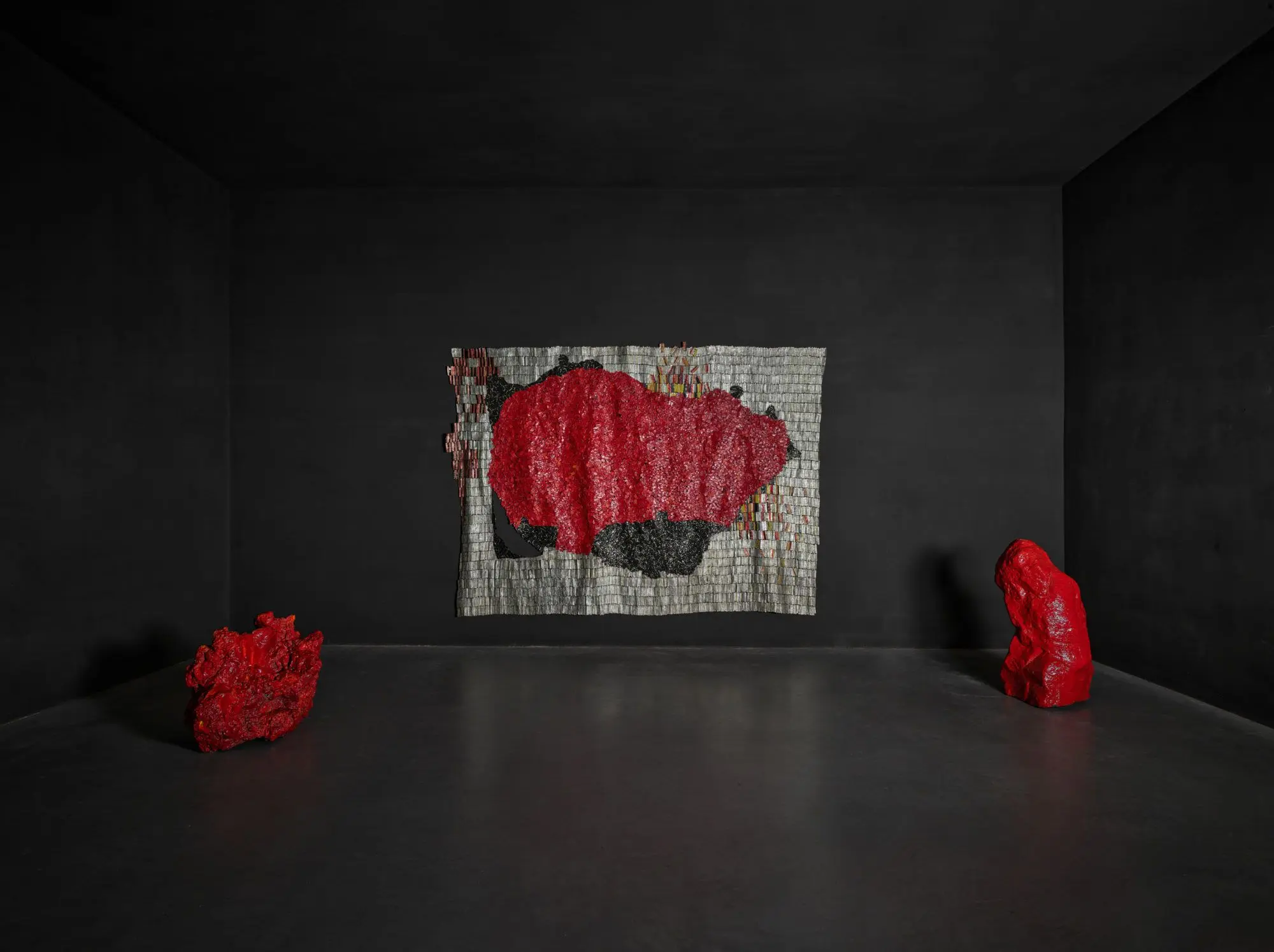
El Anatsui’s monumental installations are often mistaken for luxurious textiles.
From a distance, they resemble embroidered cloth, ceremonial garments or vast golden tapestries. Their surfaces shimmer, fold and respond to the architecture around them. Up close, however, the illusion changes. What appears to be fabric is made from thousands of small aluminium fragments, including liquor-bottle caps, seals and other discarded pieces of metal.
The material entered Anatsui’s practice unexpectedly.
During the late 1990s, the Ghanaian-born artist, who has spent much of his career working in Nigeria, discovered a bag of discarded bottle caps near his studio in Nsukka. He kept them for a long period before deciding how they might be used.
Eventually, he began cutting, flattening and folding the metal. Individual pieces were connected with copper wire, forming flexible surfaces that could be draped, reshaped and installed differently each time they were exhibited.
This freedom became central to the work. Anatsui does not treat his sculptures as fixed objects with one permanent form. Their folds and proportions change depending on the gallery, museum or building in which they appear.
One of his most recognised works, Earth’s Skin, demonstrates the power of this transformation. Its metallic surface can suggest landscapes, geological formations and flowing rivers. At the same time, the bottle caps retain connections to commerce, alcohol and the movement of goods between continents.
Although discarded materials are fundamental to his practice, Anatsui’s work cannot be reduced to a simple environmental message. He is less interested in recycling as a moral instruction than in the possibility of change.
An ordinary commercial object loses its original function and enters a completely different visual language. What once closed a bottle becomes part of an artwork that can fill an entire wall.
Afra Al Suwaidi: Childhood Objects and Uncomfortable Memories
Afra Al Suwaidi’s relationship with found materials begins inside the home.
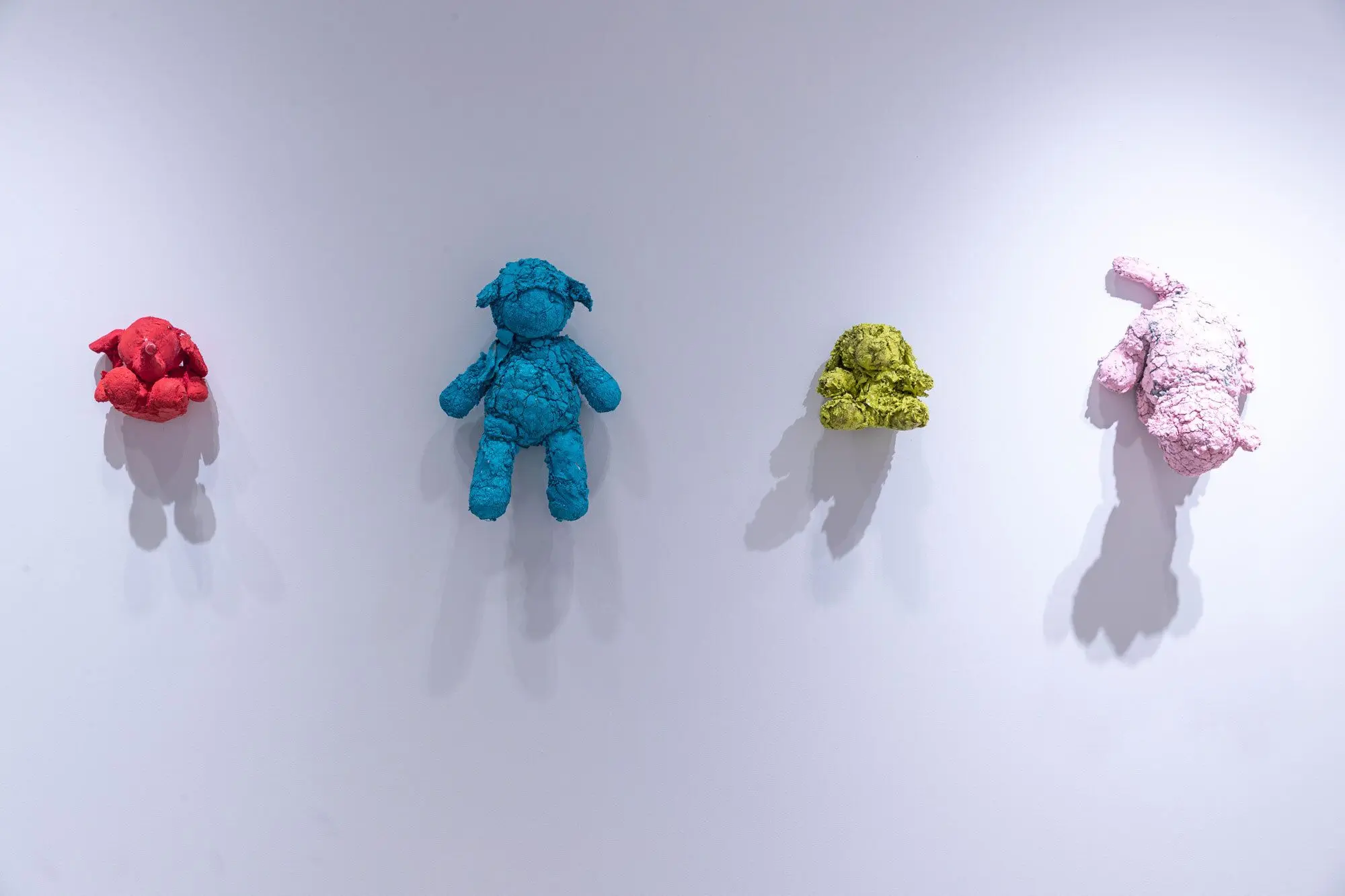
The Emirati mixed-media artist has long worked with familiar objects associated with childhood and domestic life, including toys, sweets and Lego pieces. These materials allow her to explore memory through objects that may initially appear playful, harmless or nostalgic.
Yet comfort is rarely the only emotion present in her work.
Al Suwaidi often examines the point at which familiarity becomes unsettling. A toy may represent affection and safety, but it can also carry memories of vulnerability, control or fear.
Her project Recess captures this tension through discarded stuffed animals partially covered in plaster. The softness normally associated with children’s toys is interrupted by a hard, restrictive material. The result feels suspended between play and silence.
Rather than recreating childhood as a purely innocent period, the installation considers how the same environment can produce contrasting emotions. Closeness may feel protective in one moment and threatening in another.
In 2023, during the UAE’s Year of Sustainability, Al Suwaidi expanded the materials entering her studio. Plastic bottles, old magazines, sweet wrappers and abandoned soft toys became part of her growing collection.
This development did not replace the personal themes within her work. Instead, it offered a new way to approach them.
A discarded object is something that has already been handled, used and rejected. It arrives with signs of a previous life. By incorporating these materials into her sculptures, Al Suwaidi connects environmental questions with intimate experiences of memory and identity.
Her process remains deliberately open. Materials may wait in the studio until their form, texture or emotional association suggests what they should become. The artist does not always begin with a fixed final image. Sometimes the object itself determines the direction of the work.

Ibrahim Mahama: Industrial Remains as Historical Evidence
Where Al Suwaidi often works through personal memory, Ibrahim Mahama examines the histories of labour, infrastructure and global trade.
The Ghanaian artist is known for installations of extraordinary scale. He has covered buildings with worn jute sacks and transformed exhibition spaces using railway parts, old furniture, wooden boxes and industrial remnants.
These materials are valuable to Mahama because they have participated in economic systems.
A jute sack may have transported cocoa, charcoal or grain. Before reaching the studio, it may have crossed markets, warehouses and borders. Its stains, markings and damaged fibres become records of those journeys.
Mahama does not attempt to make these objects appear new. Their wear is essential. It reveals how commodities move while the people whose labour supports that movement often remain invisible.
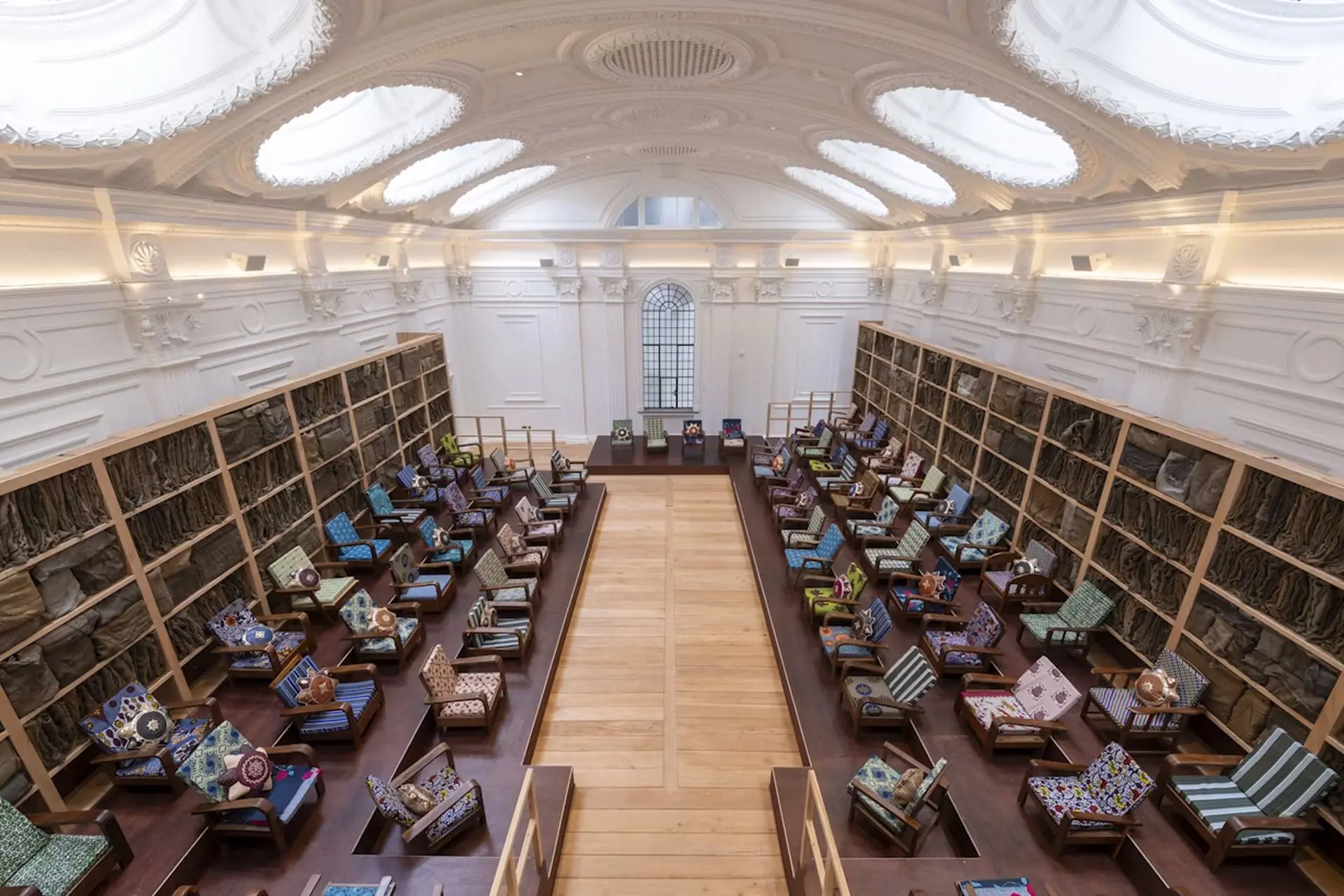
His installation Parliament of Ghosts turns towards Ghana’s colonial railway history.
The work brings together abandoned train seats, sections of railway track, station furniture and other remnants connected to a transport network originally developed under British colonial rule. That system was designed largely to move valuable resources, including cocoa, timber and minerals, towards the coast for export.
Once parts of the railway became obsolete, their physical remains were left behind.
Mahama reassembled these fragments into a space resembling a parliamentary chamber. The installation creates an imagined meeting place for neglected histories: colonial power, industrial ambition, failed infrastructure and the workers whose lives were shaped by those systems.
Collaboration is also a significant part of Mahama’s practice. Large installations are produced with groups of local workers and artisans who stitch, arrange and construct the materials together.
Their labour is not hidden behind the artist’s name. It becomes part of the meaning of the work, reflecting the same questions of production and collective effort that the installations explore.
Shareef Sarhan: Building Meaning from Destruction
For Palestinian artist Shareef Sarhan, salvaged materials are directly connected to the environment in which he has lived and worked.
His practice includes photography, design, sculpture and public art, but his use of rubble and industrial fragments carries particular emotional weight. These are not neutral studio supplies. They come from workshops, damaged structures and landscapes shaped by conflict in Gaza.
Sarhan began working more extensively with discarded aluminium and industrial remains in 2017. By bringing these fragments into his art, he prevents them from disappearing into an anonymous mass of debris.
Each piece retains a relationship with the place from which it came.
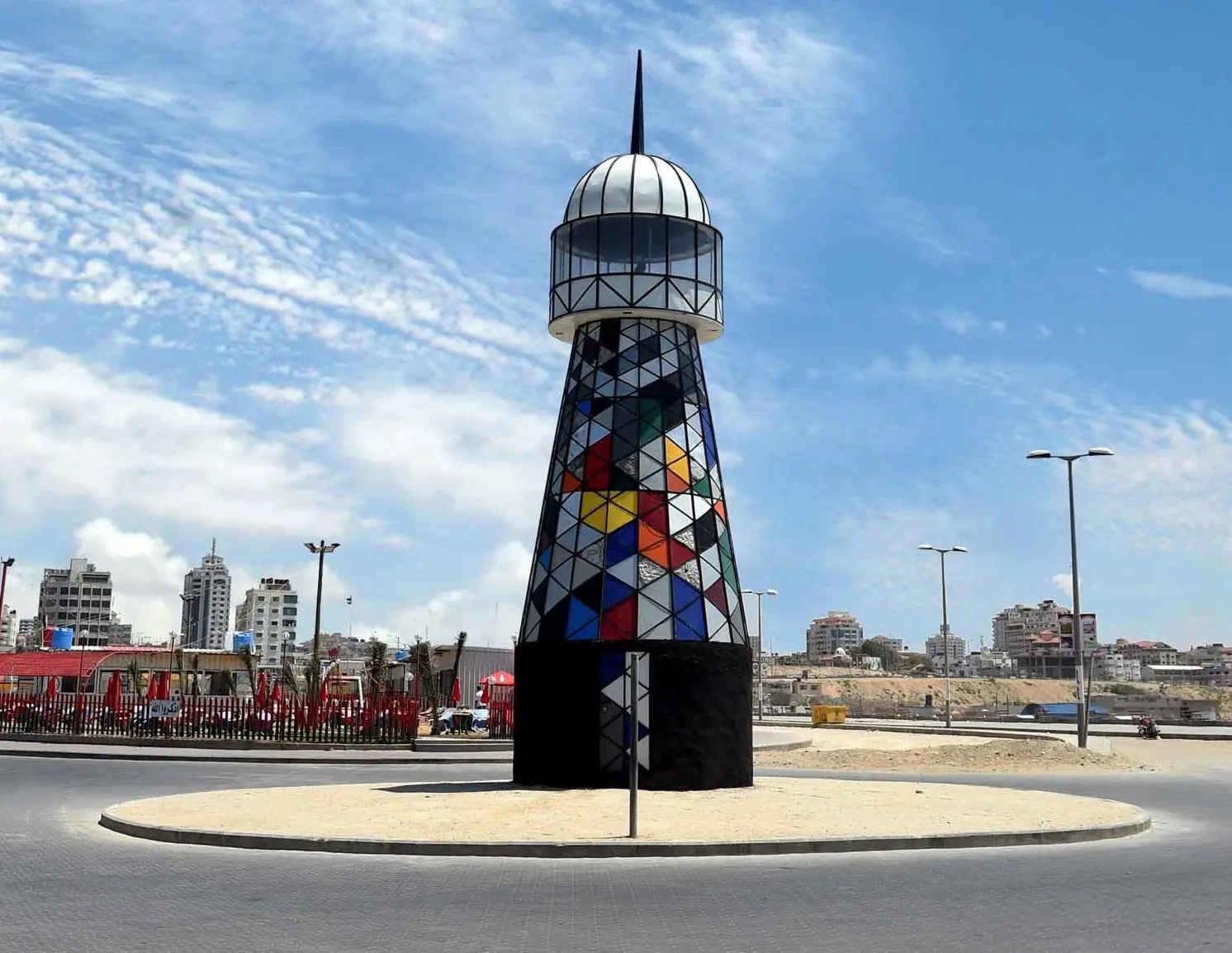
This approach is especially visible in Gaza Lighthouse, a sculpture created from materials recovered from destroyed buildings.
The choice of a lighthouse is significant. Traditionally, a lighthouse marks danger while also offering direction. It stands between uncertainty and safety, helping others navigate through darkness.
Sarhan’s work preserves that function.
Built from remnants associated with loss, the sculpture becomes a source of light. The material is not restored to its previous condition, nor is the history of destruction concealed. Instead, its meaning is redirected.
The work holds several ideas at once. It serves as a record of political and social reality, protects physical fragments that might otherwise be lost and turns them into a symbol of endurance.
Transformation here does not erase the past. It allows the past to remain visible while creating the possibility of another purpose.
eL Seed: Changing the Way a Community Is Seen
Waste is not a regular material in eL Seed’s calligraffiti practice. His work is more commonly associated with monumental Arabic lettering painted across walls, buildings and public spaces.
However, one of his most ambitious projects addresses the social meanings attached to waste and to the people responsible for managing it.
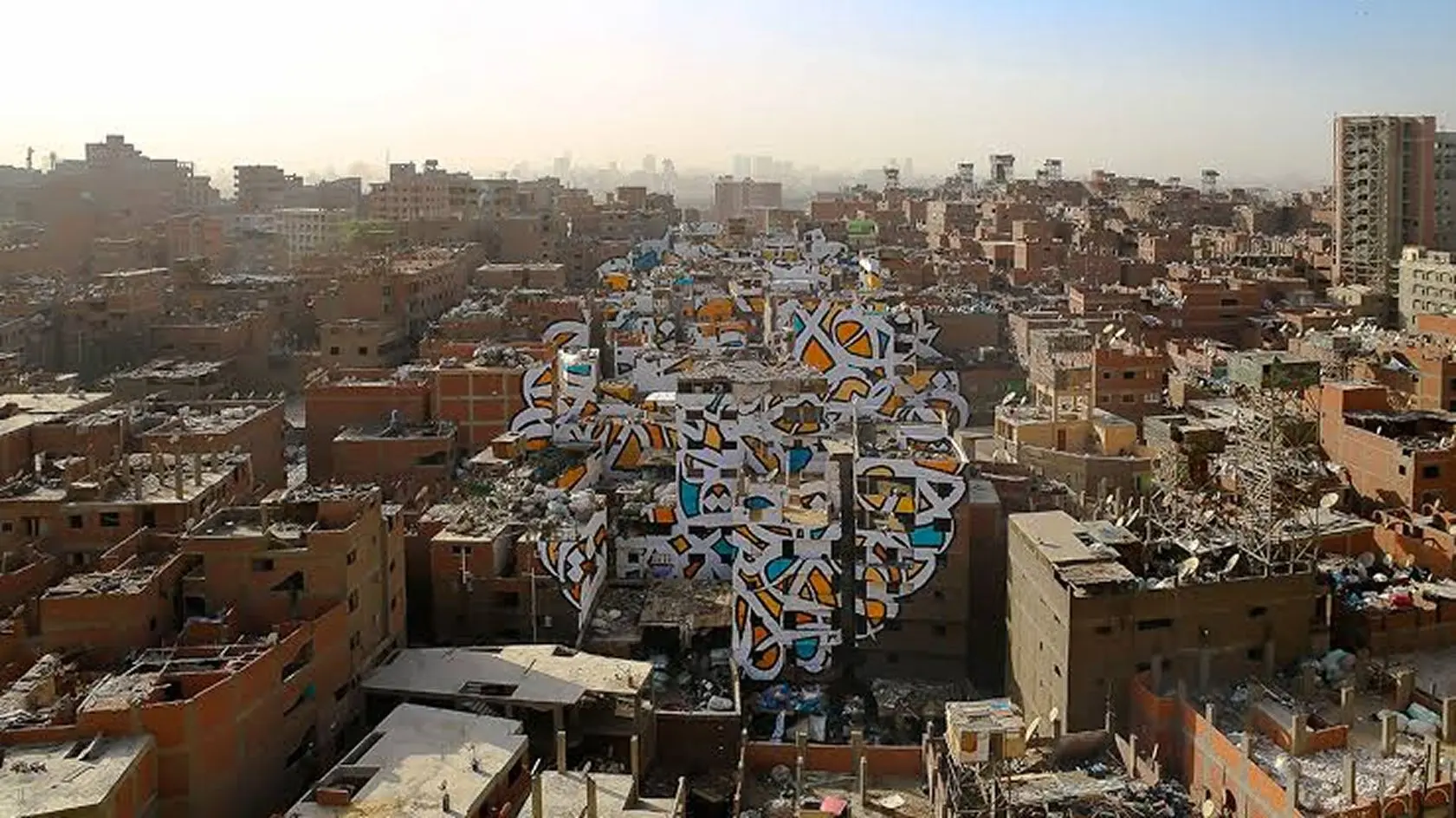
Perception stretches across more than 50 buildings in Manshiyat Naser, Cairo. The area is home to the Zabbaleen, a predominantly Coptic Christian community whose members have collected and sorted the city’s rubbish for generations.
Their recycling system is remarkably effective, with a large percentage of collected waste reused or processed. Yet the community has frequently been defined from the outside only through its association with rubbish.
This label has contributed to social marginalisation, overlooking the skill, organisation and environmental value of the Zabbaleen’s work.
eL Seed’s mural was designed to challenge that limited view.
The artwork is anamorphic, meaning its complete composition becomes visible only from a particular viewpoint. Across individual buildings, viewers see separate sections of Arabic calligraphy. From the correct position, those fragments connect into one image.
The visual structure mirrors the project’s central message. Understanding requires perspective. What appears incomplete or chaotic from one angle may become meaningful when the viewer changes position.
The text chosen for the mural was inspired by Saint Athanasius of Alexandria, a fourth-century Coptic Christian theologian. Its message suggests that seeing clearly requires people to examine and correct their own vision first.
Rather than presenting the Zabbaleen as subjects who need to be rescued or transformed, Perception directs attention back towards the audience. It asks why certain forms of labour are respected while others are dismissed, and why an entire community can be reduced to a stereotype.
Materials Do Not Forget
The work of these artists reaches far beyond the idea of giving waste a “second life.”
That phrase may suggest that an object becomes valuable only after an artist discovers it. In reality, the materials already contain value through their histories, associations and physical traces.
El Anatsui’s bottle caps connect consumption with trade and transformation. Afra Al Suwaidi’s abandoned toys hold complicated memories of childhood. Ibrahim Mahama’s sacks and railway fragments document labour and colonial economics. Shareef Sarhan’s salvaged materials preserve the memory of Gaza, while eL Seed examines the prejudice surrounding a community that has built its life around recovering what others discard.
Their work asks us to reconsider what the word “waste” actually means.
An object may lose its commercial purpose without losing its history. A damaged material may still carry knowledge. Something society has thrown away may continue to speak — provided someone is willing to look closely enough.
Latest Posts

At Dubai AI Festival 2026, the academy will showcase its hands-on training programs designed to equip enterprises, universities, and professionals with the skills to defend against emerging AI threats
After nearly a decade away, the Dubai International Film Festival is preparing to return with a fresh identity, a stronger focus on regional storytelling, and new opportunities for the film industry

Is a media outlet that is part of our agency and provides basic tools for nurturing your business.


