
Urdu Worlds at Ishara Art Foundation: Giving Visibility to a Language That Shapes Dubai
How an exhibition at Ishara Art Foundation repositions Urdu from an everyday language to a space of memory, identity, and artistic expression

Few languages occupy such a paradoxical position in Dubai as Urdu. It is woven into the daily rhythm of the city — heard in homes, markets, taxis, workplaces, and neighbourhood cafés — yet its cultural and intellectual presence often remains less visible than its widespread use would suggest.
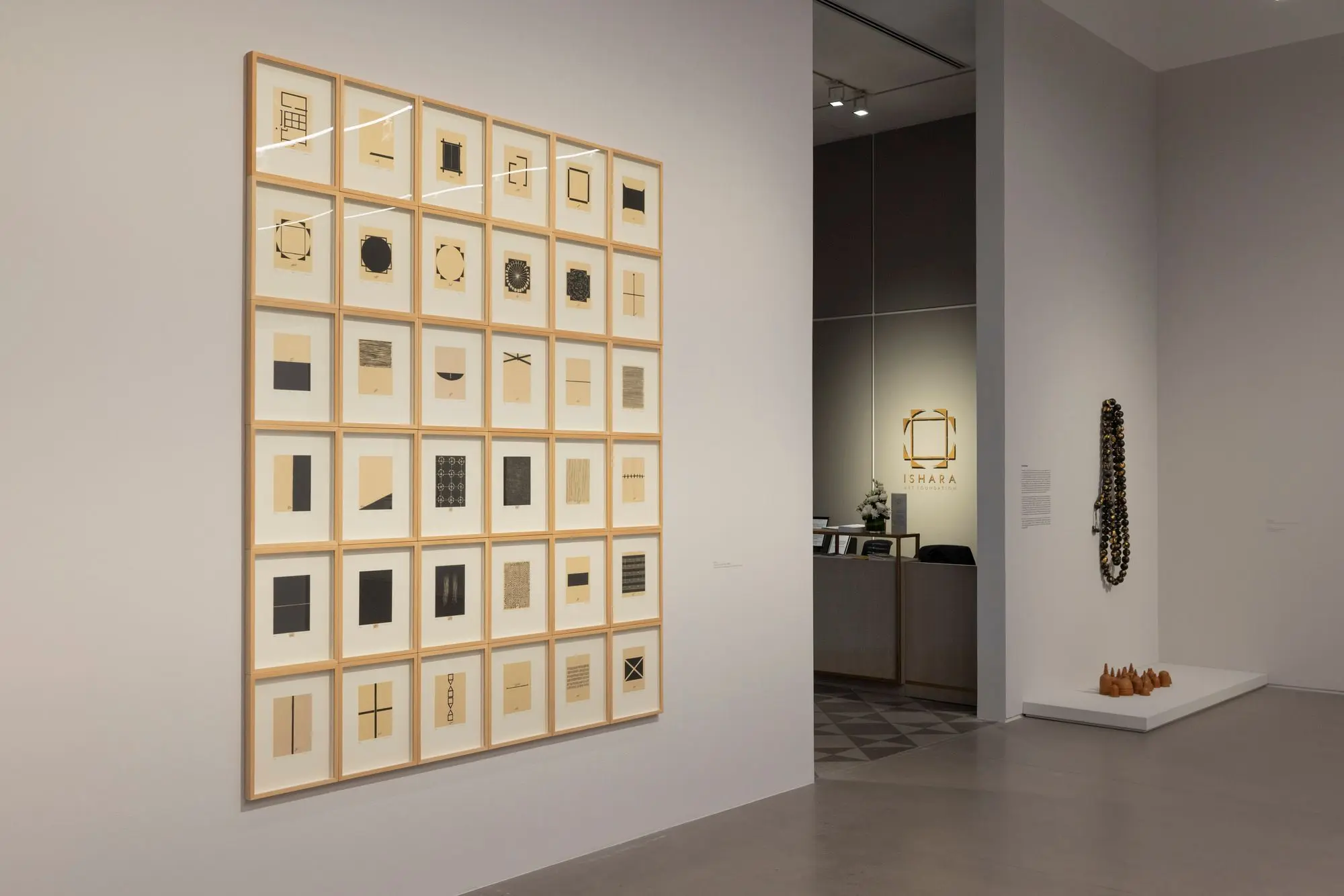
The exhibition Urdu Worlds, currently on view at Ishara Art Foundation, addresses this imbalance. Curated by Hammad Nasar, the exhibition brings together works by renowned artists Zarina and Ali Kazim to explore Urdu not simply as a language, but as a framework through which people experience memory, migration, identity, and belonging.
Rather than presenting Urdu as a relic of heritage or a symbol of nostalgia, the exhibition positions it as an active cultural force. This approach feels particularly relevant in the UAE, where Urdu has played an important role in shaping society while rarely occupying a prominent place within institutional cultural discourse.
Language Beyond Translation
One of the exhibition’s strengths lies in its refusal to simplify Urdu for audiences unfamiliar with it. Instead of translating every nuance, the works encourage viewers to engage with the language through emotion, form, and atmosphere.
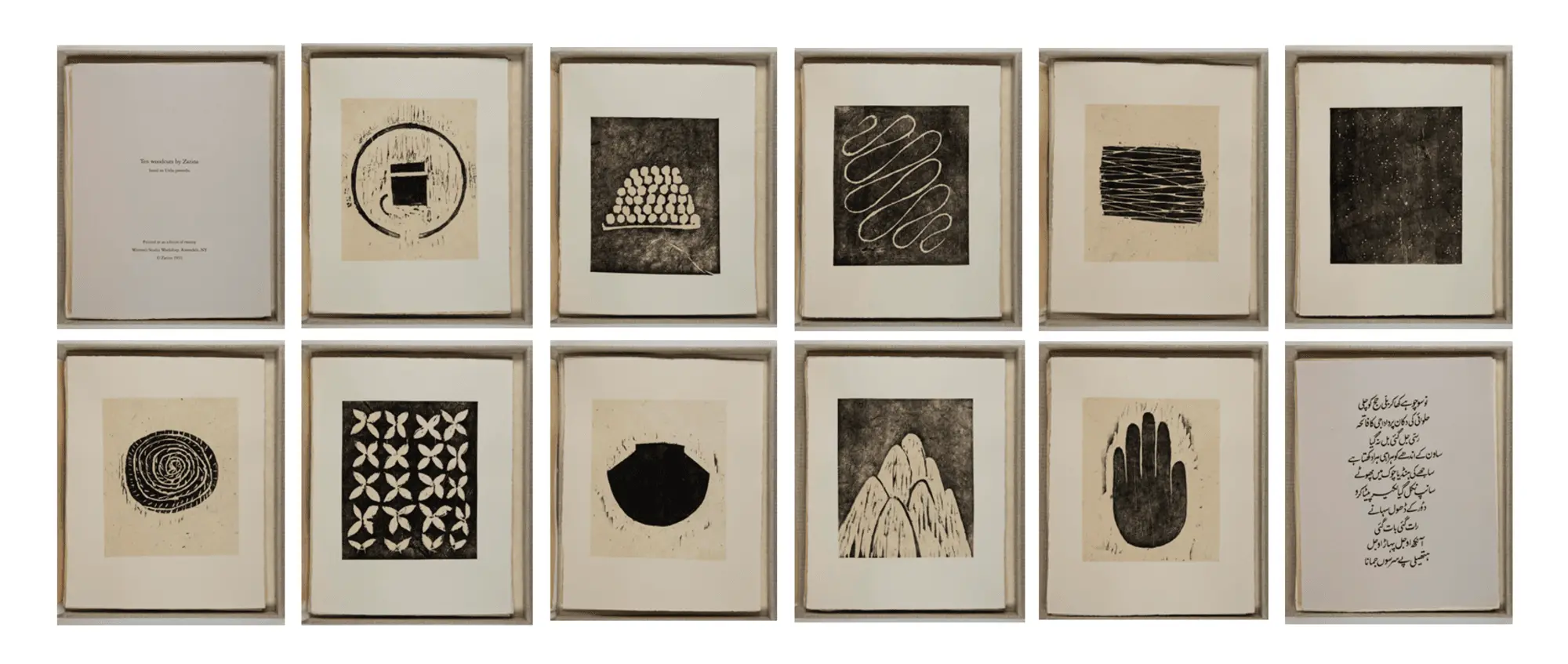
Zarina’s celebrated series Home is a Foreign Place exemplifies this approach. Through delicate woodcuts paired with individual Urdu words, she creates visual meditations on concepts such as home, memory, absence, and language itself. Even viewers who cannot read Urdu are invited into an emotional landscape that transcends literal understanding.
Her works demonstrate that language can communicate through texture and feeling as much as through direct meaning. The viewer senses the weight of a word before fully understanding its definition.
This becomes even more apparent in Zarina’s exploration of Urdu proverbs. These expressions carry generations of cultural memory, social context, and collective wisdom. Rather than attempting to fully explain them, the exhibition allows some of their complexity to remain intact, highlighting the inevitable distance that exists between languages and cultures.
Landscapes as Memory
Where Zarina works through reduction and precision, Ali Kazim approaches language through accumulation and materiality.
His paintings and etchings connect landscape, history, and memory in ways that suggest language itself can be embedded within physical environments. Fragments of earth, vegetation, birds, ruins, and archaeological traces appear throughout his works, functioning almost like an alternative form of writing.
Among the exhibition’s most striking pieces is Tteela, a large-scale work that evokes layers of history buried beneath the surface. Rather than presenting language as something fixed, Kazim suggests it is constantly shaped by time, erosion, and inheritance.
For many Urdu speakers, his works prompt a personal reflection: how much of a language survives through successive generations, particularly in societies where multiple languages compete for space and visibility?

The Challenge of Preservation
The exhibition occasionally touches on familiar conversations surrounding cultural preservation. A reading room located on the mezzanine level expands the project’s literary dimension, introducing visitors to Urdu’s rich intellectual traditions through books, texts, and references.
While this addition enriches the exhibition, it also raises questions about accessibility. At times, the atmosphere can feel closer to an archive than to the everyday realities of a language spoken by millions across diverse social and cultural backgrounds.
This tension reflects a broader challenge faced by many linguistic communities: how to celebrate cultural depth without turning language into a museum object disconnected from contemporary life.
From Everyday Speech to Artistic Reflection
Perhaps the exhibition’s most important contribution lies in the way it reframes Urdu within the context of Dubai.
In the Gulf, Urdu is often encountered in practical or transactional settings. Urdu Worlds invites audiences to experience it differently — as a medium of artistic expression, philosophical thought, and cultural imagination.
By placing Urdu within a contemporary art institution, the exhibition shifts perceptions of the language from functionality toward contemplation. It asks viewers to consider who is afforded the opportunity to experience a language aesthetically, rather than simply as a tool of communication.
A Broader Conversation About Visibility
Recent cultural initiatives in the UAE have understandably emphasised the importance of Arabic within public and institutional spaces. Against this backdrop, Urdu Worlds offers a complementary perspective rather than a competing one.
The exhibition serves as a reminder that many languages present within the UAE carry equally complex histories, literary traditions, and artistic legacies, even when they remain less visible in official cultural narratives.
What makes the exhibition particularly effective is its refusal to provide a single conclusion. Zarina’s intimate, minimalist works and Kazim’s expansive, layered compositions offer two very different visions of what Urdu can represent. One condenses meaning into distilled emotional moments; the other spreads it across geography, history, and collective memory.
Together, they create a conversation rather than an argument.
What Languages Carry Forward
For many people who grew up in multilingual environments such as the UAE, language is often negotiated daily. Urdu may be spoken at home, while English or Arabic dominates education, business, and public life. Such shifts can gradually reshape not only vocabulary but also cultural connections and forms of self-expression.
Urdu Worlds quietly draws attention to these realities. It encourages reflection on what is gained through adaptation and what may be lost when a language becomes increasingly absent from public cultural spaces.
Ultimately, the exhibition is less concerned with preserving Urdu as an object than with recognising it as a living, evolving world. It asks audiences to consider how languages survive not only through institutions, but through the communities and individuals who continue to think, create, and imagine within them.
Urdu Worlds remains on view at Ishara Art Foundation until 8 June 2026.
Latest Posts

From homegrown pioneers to globally recognised names, these six brands are redefining what streetwear looks like in Dubai and the wider GCC.
On Tuesday, June 2, Dubai’s business and technology ecosystem will mark a significant milestone as Dubai Tech Tuesdays hosts its 100th edition, underscoring the rapid evolution of one of the city’s most influential networking and intellectual platforms.

Is a media outlet that is part of our agency and provides basic tools for nurturing your business.


