
Alya AlSalmi: Dressing a Nation on the World’s Most Prestigious Stage
An Exclusive Interview on Heritage, Vision, and Global Recognition Introduction
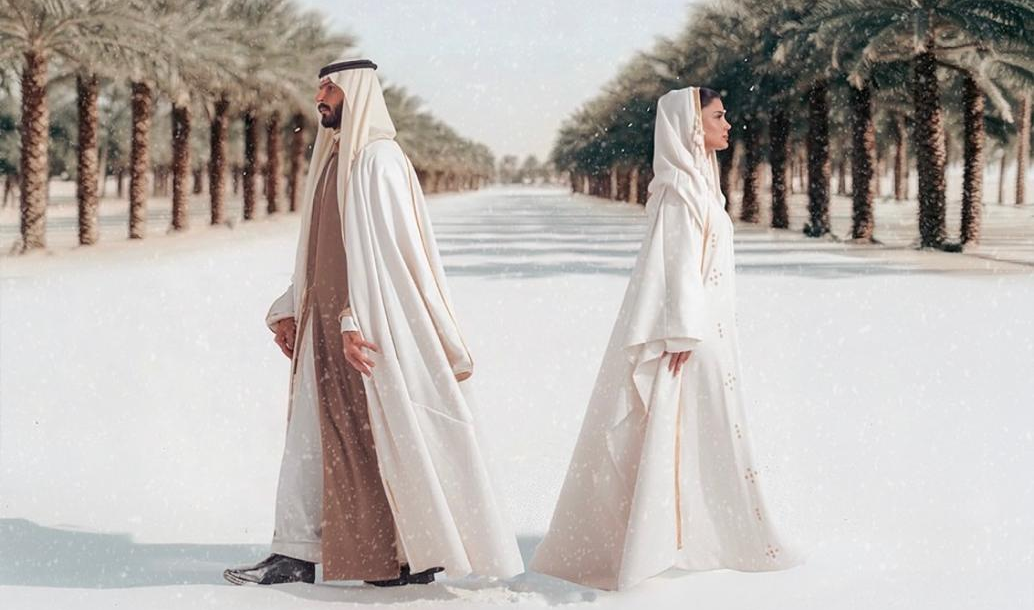
Few designers carry the weight of a nation’s aesthetic evolution as gracefully as Alya AlSalmi. By translating ancient motifs into a sharp, modern vernacular, she has moved beyond 'influential' to become the definitive architect of Saudi Arabia’s new creative soul.
Amidst the high-octane buildup to the Milano–Cortina Winter Olympics, AlSalmi didn’t just show a collection; she staged a cultural tectonic shift.
As the creative architect behind Team Saudi’s historic appearance—the sole Arab nation to grace the runway—she sent cross-country skier Rakan Alireza out in a bespoke silhouette that felt less like a uniform and more like a manifesto. It was the moment Saudi design captured international attention.
AlSalmi has long been celebrated for her alchemy, taking the rigid threads of heritage and weaving them into fluid, modern armor. But Milan was different. The impact was both global and deeply felt, a definitive signal that Saudi craftsmanship had arrived at the center of the world’s elite landscape.
We joined AlSalmi to trace her creative journey and discover how she balances the quiet intimacy of the atelier with the public gravity of defining a national identity on the world stage.
.JPG)
Part I—The Olympic Stage & Milan Experience
— Alya, congratulations—Milan felt less like a showcase and more like a cultural manifesto. You’ve moved from the vibrant, kinetic 'summer energy' of Paris into a much more atmospheric, structural vernacular for the Winter Games. When you began sketching for Milano–Cortina, how did you pivot from that summer adrenaline to the quiet gravity of the mountains?
— Thank you very much.
There is a specific kind of gravity that comes with dressing a nation. When the committee selected me, the pride was immediate, but so was this looming sense of duty that stayed with me through every fitting. All of that tension culminated in Milan—until Rakan hit the runway. Watching his stride change as he realized the world was looking at a new Saudi identity, the pressure just vanished. His confidence was the best possible feedback.
The Paris Olympics was entirely different, as it was my first experience in the Olympic world. Still, both these participations aim to highlight Saudi culture on a global level, despite the differences in climate and materials used in each.
— Can you tell us about the creative process behind the Milano–Cortina ensemble—from the initial concept to how you transformed specific motifs from Saudi heritage into a winter look?
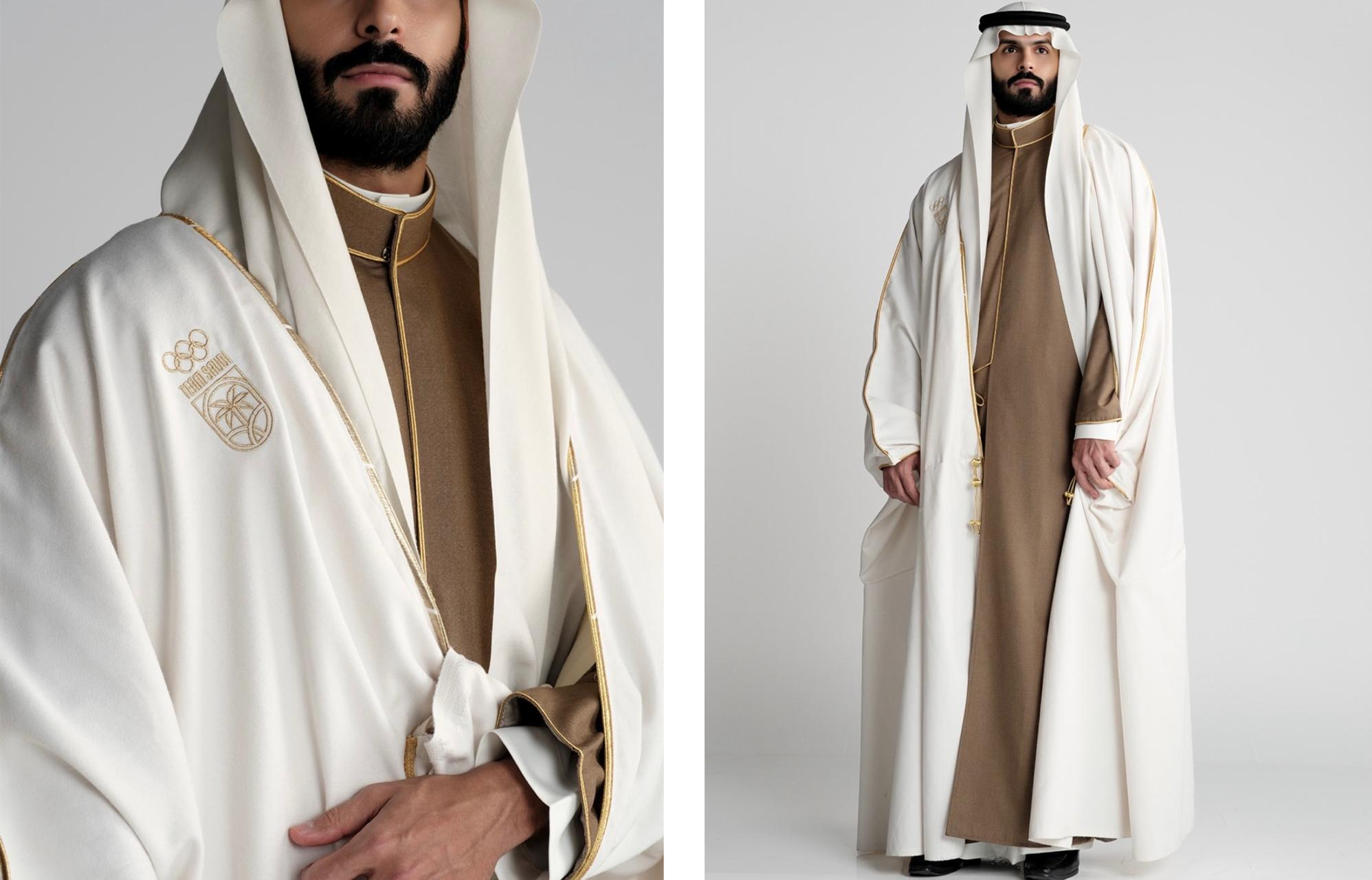
— Dressing for a nation means honoring its vastness. In Rakan's look, I curated a three-layer ensemble that speaks to every corner of our heritage.
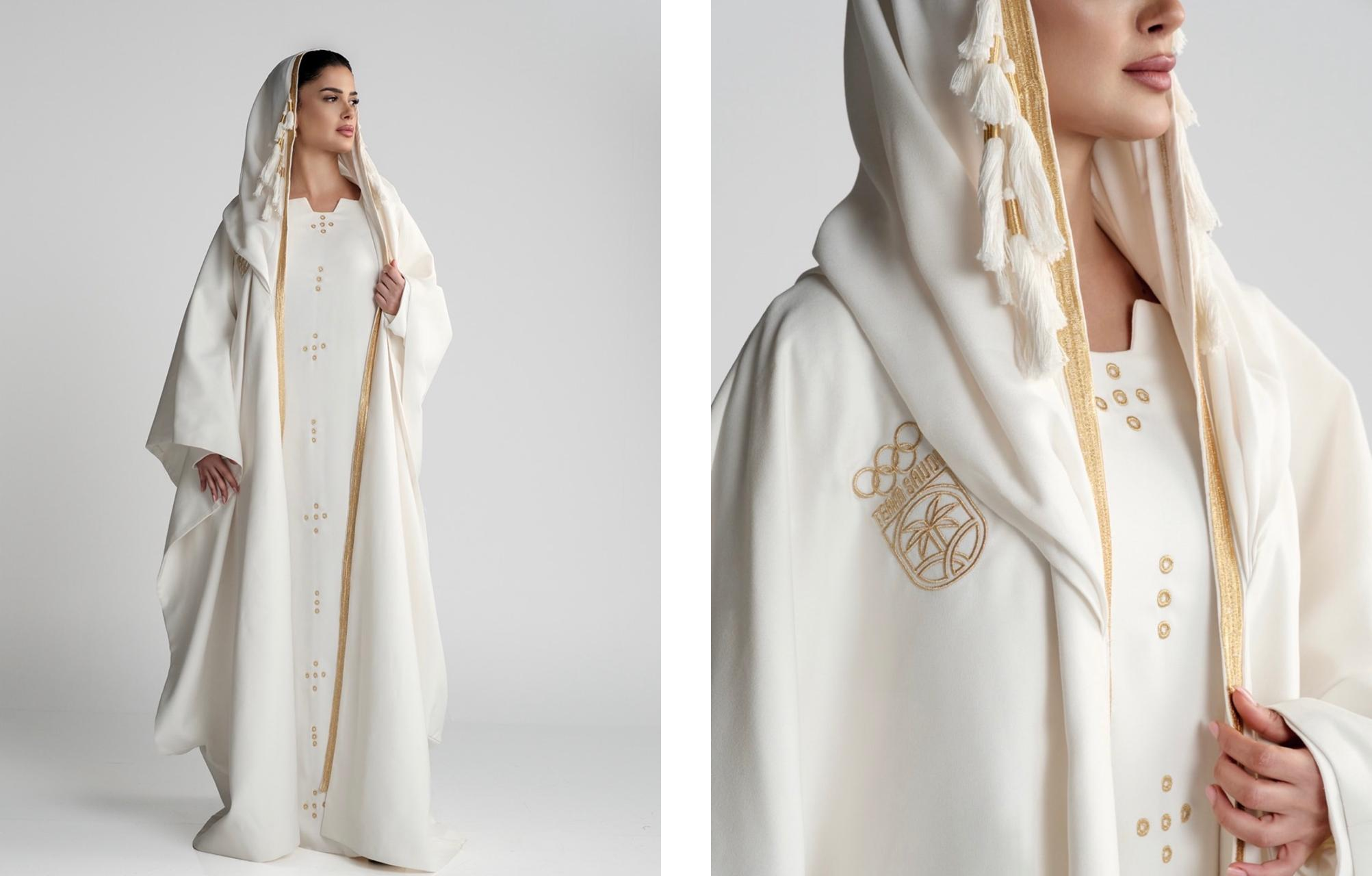
The base layer is the thobe. It’s the standard, full-coverage garment that every Saudi man wears daily. Over that, I added the saya. It’s a more formal, open-front robe that you typically see during the Najdi Ardah. It has this specific structure that gives the whole look a sense of ceremony without losing that traditional silhouette. The saya has long sleeves and side openings, fastened with a thin ribbon at the waist.
The final piece is the bisht. It’s a traditional cloak for formal occasions, and we're very proud of it—UNESCO even added it to their cultural heritage list in 2025. Since we were designing for the cold in Milan, we used a heavy, protective winter wool. We had it hand-woven with gold thread so that it catches the light. It gave a really striking, polished look against the winter backdrop.
For the women's look, I went back to the Thoub Al Musaddah. It’s one of our most iconic traditional pieces, specifically known for those distinct dotted patterns and that deep, striking blue. It’s got such a recognizable character, and I wanted to use that as the foundation to show how our heritage can feel completely modern. I designed it in a modern way with a head covering connected to the garment from top to bottom and decorated with “Bairam” fringes. I handmade it with my mother under the supervision of my respected teacher Fatimah Al Talhi. The white color was chosen according to the protocol of wearing the bisht in the Kingdom of Saudi Arabia on Friday, as each day of the week has its own specific color.
.JPG)
— Designing for an athlete like Rakan Alireza is a unique task. How did his persona and the needs of a winter sport influence the silhouette and functionality of the garment?
— Our primary goal in international participation is to highlight authentic Saudi identity. And this is what we achieved in this historic participation, as the Kingdom of Saudi Arabia was the only Arab country participating in this show.
— Milan is a demanding fashion capital. Besides, there is always a delicate tension when you’re translating a local soul for a global stage. What was the most complex part of that 'fashion translation'?
— There’s a certain electricity in Milan that demands you bring your absolute best. I’m so grateful to the committee for trusting my vision on such a storied stage. The way the audience reacted was incredible. People are so much more curious now—they aren't just looking for something that looks good on a runway. They’re looking for a story and a culture they can actually connect with.
.JPG)
Part II—Heritage, Identity & Design Philosophy
— Saudi heritage is central to your work. For you, what is the secret of making traditional Saudi elements feel wearable for an international audience?
— My process is a constant dialogue with our archives: pulling the rhythmic patterns, the sun-baked palette, and the generous cuts of our heritage into a contemporary light. But the soul of the work remains in its modesty.
For me, modest fashion is a deliberate, architectural choice. It aligns so naturally with our traditional vernacular, and I’ve found that the global stage is increasingly captivated by that sense of mystery and elegance.
— Your Milan ensemble was considered a strong statement of national identity. Do you view fashion today as a form of cultural diplomacy — and how conscious are you of this role in your work?
— Certainly, fashion today has become integrated into most fields as a form of soft power through which many matters are highlighted. Through it, societies express their customs, traditions, and aspirations and also convey messages.
Last year, I had the privilege of taking our narrative to Washington for the Diplomatic Fashion Exhibition at the historic Wilson House. It was a truly profound moment of sartorial diplomacy. The design represented the Kingdom of Saudi Arabia among countries, aiming to build dialogue, understanding, and peace between cultures.
Part III—The Journey & Building a Global Brand
— Your journey into fashion is inspiring. Did you have a clear moment when you realized “I'm going to be a designer one day"?
— I had a great example in front of me: my mother is a fashion designer. As a kid, I always went to fabric stores with her and then carefully followed all the stages of her designs.
At fifteen, I started to experiment myself—with silhouettes and styling. I liked the idea that I didn’t have to just leave traditions as they were: I could take the things I grew up with and reshape them into something that felt like me.
— Every creator has a moment where their work stops being a local conversation and begins to resonate globally. Was there a specific 'lightning strike' moment for you?
— Certainly. I would say it was the profound trust of the Saudi Olympic and Paralympic Committee. This leadership views culture as a vital pillar of our future. The support I got for the Paris 2024 opening ceremony changed everything. To me, that moment was really about the Kingdom’s confidence, this belief that our style actually belongs on a global stage. It gave me the push I needed to really trust my own creative instincts.
— The Olympics was obviously a giant moment for you. How did that whole project actually get started?
— In 2024, I got an email invitation from the Saudi Olympic and Paralympic Committee. They offered me the chance to join a design competition and make some outfits for the opening ceremony of the Paris Olympic Games. Apart from me, there were 128 designers. It happened that my work was chosen from among all the other participants, so I joined the Olympic Games.
.JPG)
— Such high-profile projects inevitably come with pressure. What were the greatest challenges you faced while preparing Olympic designs?
— I think I was lucky: no challenges or obstacles with the Saudi Olympic and Paralympic Committee. They are supportive, understanding, and continuously follow the progress of the work to present the Saudi team in the best possible image.
Part IV—Growth, Strategy & The Future
—Today, your brand has global visibility. What core strategy helped you expand beyond the region, and how do you balance creative freedom with commercial demands?
— I would say it's about clear vision, continuous development, and commitment to participating in global forums. I take commercial requirements into account and present them in a clear form, because excellence is necessary and mandatory, especially in a highly competitive environment.
— How could you describe the changes Saudi fashion is bringing to the global stage?
— Vision 2030 has changed how we look at Saudi fashion: not just an industry anymore but a core part of who we are. It’s given designers the chance to use our work as a way to connect with the rest of the world. Vision 2030 has stopped being just about making clothes; we’re actually building the history of Saudi fashion in real-time.
As a designer, I must be influential. That's why I strive to participate in global forums to achieve these goals in the best and most beautiful way.
.JPG)
— What about the future? Are there any new fields or collaborations that come to your mind?
— I've always had a great ambition: to show what Saudi excellence actually is. As a designer and a Saudi woman, I want to present to the world a unique perspective on our culture. I will always keep going on this path; don't think our heritage is something you ever finish exploring.
Closing Note
Alya AlSalmi has shown that Saudi heritage is meant to be worn and reimagined.
Winning the commission for Paris 2024 against 128 other designers was a clear signal that Saudi design is ready for a much larger conversation. Whether she’s representing the Kingdom in Washington or navigating the high-pressure world of international fashion weeks, AlSalmi is proving that her work isn't just 'local.' And now, she's helping define the visual future of the country.
Latest Posts

Lighter tailoring, luminous eveningwear and unexpected construction bring fresh energy to the French fashion houses
Family entertainment, costume brunches and rooftop celebrations—six ways to spend Halloween in Dubai this year

Is a media outlet that is part of our agency and provides basic tools for nurturing your business.


